
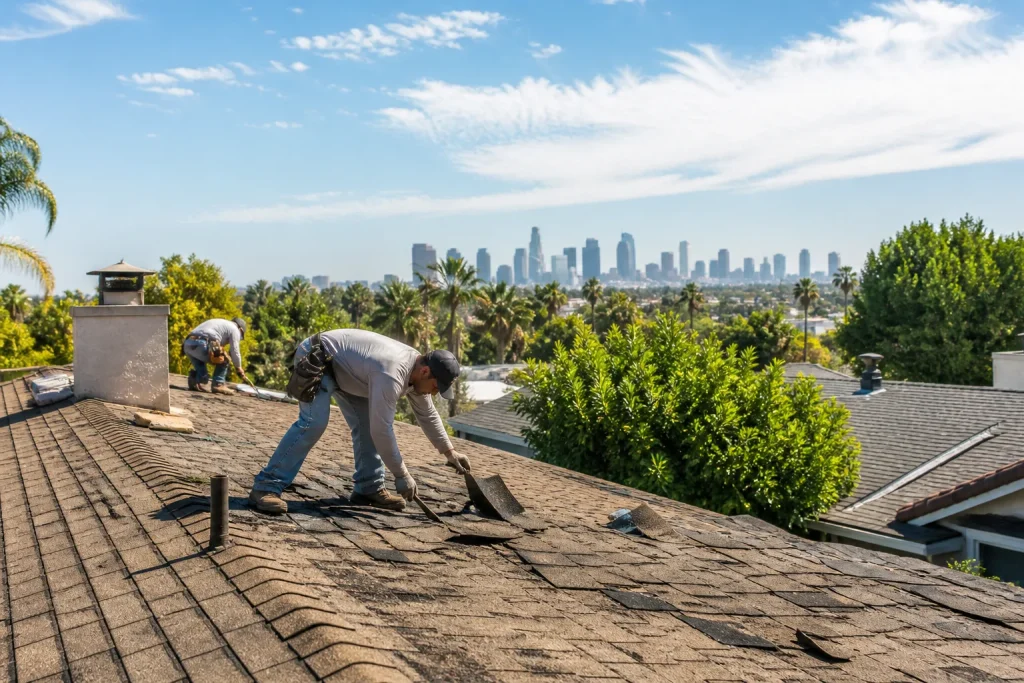
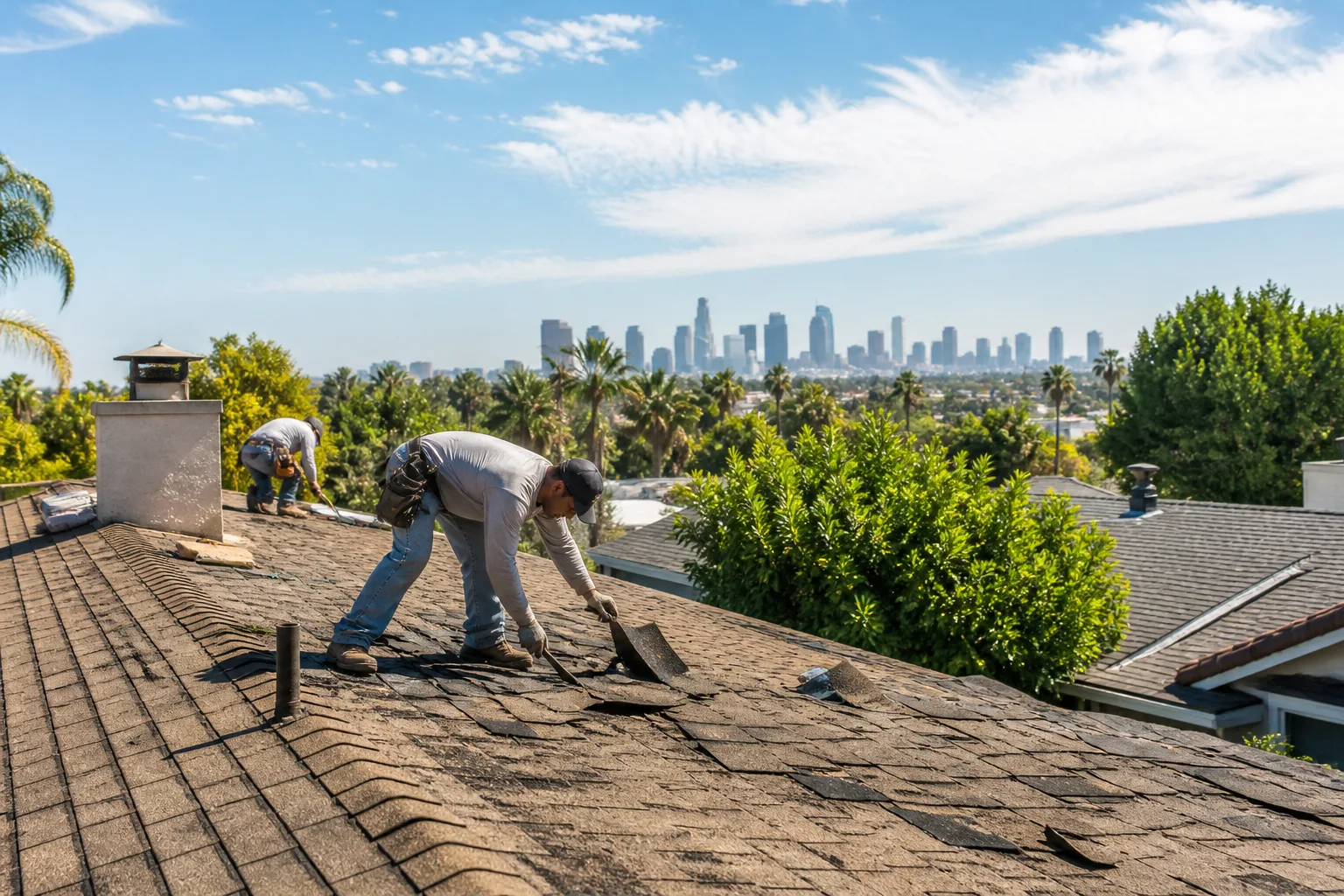
Roof Installation: Repair or Replace? How Los Angeles Homeowners Decide
Repair or replace a roof in Los Angeles? For most LA homes, a repair makes sense when damage is isolated to one slope, flashing, or a small section of decking, and the roof is under 15 years old. A full replacement becomes the better financial call when the roof is past 20 years, shows widespread granule loss or UV cracking, or when LA permit and Title 24 cool-roof requirements would trigger a large portion of the roof to be brought up to code anyway. If you’d rather not sort through the math yourself, call (743) 200-8347 and we’ll walk you through it with a written price before any work starts.
Most homeowners assume the repair-versus-replace decision hinges on one number: how many square feet of shingles are damaged. That’s the “20-year rule” or the “30% damage threshold” you see in every roofing guide. It’s not wrong, but in Los Angeles it’s incomplete. We’ve written estimates in neighborhoods from Sherman Oaks to Eagle Rock where a roof looked repairable on the surface, but the real decision came down to something the homeowner had never heard of: how much of the existing roof would trigger compliance work under Title 24 once permits got involved. That’s the variable that changes the math.
This guide gives you the actual decision framework we use with homeowners across Los Angeles. No damage-percentage guesswork. Just the five factors that determine whether repair or replacement is right for your house, your budget, and your long-term plans.
Key Takeaways
- LA’s dry climate means some roofs outperform the “20-year rule,” but UV degradation can also shorten a roof’s life in ways that look different from rain-driven damage.
- LADBS permit thresholds and Title 24 cool-roof requirements can force a “repair” into compliance work that costs more than the repair itself.
- A neutral inspection report is a different document from a repair estimate. Get the inspection first.
- SCE and LADWP rebate programs can offset replacement costs by hundreds of dollars, but timing matters.
- The document that makes this decision clear is a written scope comparison with itemized 10-year cost projections.
The 20-Year Rule: Why It Half-Works in Los Angeles
Roofers across the country lean on a simple heuristic: asphalt shingle roofs last 20 to 25 years. By year 20, the argument goes, a roof has done its job and replacement is the responsible call. In damp climates with freeze-thaw cycles, that rule is fairly reliable. Los Angeles is not that climate.
We’ve inspected roofs in neighborhoods like Mar Vista and Glassell Park that were 25 years old and still shed water fine. Why? Los Angeles gets around 15 inches of rain a year, and the rest of the time the roof is dry. The mechanisms that kill roofs elsewhere (standing water, ice dams, moss, freeze-thaw expansion) simply don’t happen here with the same frequency. A well-ventilated roof on a Los Angeles home can legitimately outperform the 20-year benchmark.
But here’s the part most guides miss: the thing that kills LA roofs is not water. It’s the sun. Prolonged UV exposure breaks down the asphalt in shingles, causing them to become brittle, curl at the edges, and shed granules onto the ground. You’ll see it on south-facing slopes especially. A roof in Atwater Village with southern exposure can look worse at year 12 than a heavily shaded roof in Los Feliz does at year 20. The 20-year rule assumes a national average that doesn’t match how roofs actually age in this city.
So the number matters less than the condition. A 22-year-old roof with intact granules, no curling, and working flashing may have years left. A 12-year-old roof on a south-facing slope with widespread granule loss may be closer to the end than the homeowner suspects. The only way to know is to walk it and look, which is exactly what our technicians do during every inspection. If you’d like a set of trained eyes on your roof, the team at Mercer Roofing home is one call away at (743) 200-8347.
When a Repair Triggers a Permit: LADBS Thresholds and Title 24
Here’s where the Los Angeles repair-versus-replace decision gets genuinely different from anywhere else in the country. The Los Angeles Department of Building and Safety (LADBS) has specific thresholds for what counts as a repair versus a reroof. And once you cross into reroof territory, Title 24 energy code kicks in, which for roofing usually means cool-roof requirements.
Under LADBS rules, replacing up to 50% of a roof’s surface area within a single year is considered maintenance and typically does not require a full building permit. Cross that 50% threshold and the city treats the work as a reroof. That means permits, inspections, and compliance with current Title 24 cool-roof standards for the entire roof, not just the section you’re fixing.
What does that mean in practical terms? Suppose you have a 20-year-old roof with a leak on the west slope. A contractor quotes you a repair for $2,400. But the repair involves replacing 55% of the roof surface because the damage runs wide. Once the city sees that scope, the work is a reroof. Now you’re installing a cool-roof-compliant shingle across the entire roof, pulling permits, and scheduling inspections. The math shifted. Your $2,400 repair just became a $14,000 compliance-driven replacement.
This is the moment most Los Angeles homeowners realize they should have known about the threshold before signing a repair contract. A good roofer will tell you where your project falls on that line before quoting. A great roofer will show you the math and let you decide. If you’re unsure where your roof falls, the team behind Roof Repair in Los Angeles can walk you through it with real numbers in writing.
Get an Inspection Report Before You Get a Repair Estimate
Most homeowners call a roofer and ask, “What will it cost to fix this?” The roofer climbs up, looks around, and writes a repair estimate. That’s the standard flow, and it has a built-in problem: the person writing the estimate has a financial interest in the recommendation. Even honest roofers see the roof through the lens of “what can we fix and what should we replace?” You deserve a document that’s built to answer a different question.
An inspection report answers: What is the condition of this roof right now, in specific, itemized terms? What is the expected remaining life? What will fail in the next 12 months, 3 years, and 5 years? What is the cost to repair each item versus the cost to replace the roof, projected over a 10-year window?
That’s a different document from a repair estimate. A repair estimate says, “Here’s what I’d charge to fix the leak.” An inspection report says, “Here’s the whole picture, whether or not you hire me.” In Los Angeles, where the repair-versus-replace call often swings on permit thresholds and title compliance rather than obvious damage, you want the whole picture before you commit to either path.
When we inspect a roof, we document everything in writing before any price is discussed. The homeowner sees what we see: photos, notes on decking condition, flashing age, ventilation, and a written assessment of remaining life. Then the price comes. That order matters. None of the national guides mention this, but in our experience, paying for a neutral inspection first saves Los Angeles homeowners thousands in bad repair decisions. We pulled one out of a garage over in West Adams last month where a homeowner had been told by another company she needed a full replacement. The roof had 8 years left. She needed a repair and a new vent boot. That’s the difference a real inspection makes.
SCE and LADWP Cool-Roof Rebates: The Timing Variable
Southern California Edison and the Los Angeles Department of Water and Power both run rebate programs for cool roofs. These are not new programs, but most Los Angeles homeowners don’t know they exist. And the rebate can be significant enough to change the repair-versus-replace math in ways you should calculate before deciding.
Cool-roof rebates work like this: when you install a roof with high solar reflectance, the utility company pays you back a portion of the cost, usually a few hundred dollars depending on the program and the roof’s reflectance rating. The rebate is typically calculated per square foot, and it’s paid after the roof is installed and the reflectance is verified. The exact amount shifts with program funding cycles.
Why does timing matter? Utility rebate programs are not open-ended. They run on annual funding, and once the budget is drawn down for the year, the rebate window closes until the next cycle. We’ve had clients in Los Angeles who replaced a roof in October and missed a rebate that would have been available in March. The difference was $300 to $600 depending on the roof size. When you’re staring at a repair bill of $3,500 versus a replacement bill of $15,000, $600 won’t decide for you. But when the repair-versus-replace math is already close, a $600 rebate plus the long-term benefits of a compliant roof can tip the scales.
If you’re considering replacement in Los Angeles, ask your roofer two questions before you commit: “Is this roof cool-roof compliant under Title 24?” and “Am I timing this to qualify for an SCE or LADWP rebate?” If your roofer can’t answer both, you’re working with someone who doesn’t understand how roofing actually works in this city.
The Document That Makes the Decision Clear
There’s one document that, if every homeowner had it, would make the repair-versus-replace decision nearly automatic: a written scope comparison with itemized 10-year cost projections. Here’s what it looks like.
Column one lists the repair option. It itemizes exactly what would be repaired, the cost of each line item, the expected lifespan of the repair, and the projected maintenance and follow-up repair costs over the next 10 years. Column two lists the replacement option. Same structure: full scope, cost, expected lifespan, and projected maintenance costs over 10 years. At the bottom, you see the total cost of ownership for each path over a decade.
When you put both options on paper this way, the decision typically resolves itself. Repair might show a $3,200 outlay today, but with projected follow-up work, the 10-year number could be $8,500. Replacement might show a $14,000 outlay today, but the 10-year number could be $15,800, with a new roof under warranty for most of that time. The $7,000 gap in up-front cost shrinks to something the homeowner can weigh against real numbers, not vague feelings.
Any roofer can hand you two numbers on a napkin. What clears the fog is seeing the line items and the decade math in writing. We include this scope comparison with every estimate we write in Los Angeles because we’ve seen what happens when homeowners don’t have it: they make decisions based on whoever’s voice was most persuasive on the phone that week, not on the actual economics of their roof. You don’t have to guess. You just have to ask for the document. If you’re comparing roofers and want to see this from us, the team at Roofing Company in Los Angeles can put one together for your home.
When to Call a Pro
There’s a point in every roof investigation where you step back and decide whether to keep climbing the ladder or hand the thing to someone who does this daily. Here’s the honest line: if you see visible sagging in the roofline, water stains spreading across ceilings, shingles curling or cracking across multiple slopes, or you’re on a second story with a pitch steeper than about 4:12, don’t get on that roof. Roof work on a pitched surface carries real fall risk, and a two-story Los Angeles home with a steeper pitch is not the place to learn. A trained professional with proper safety gear is the only right call at that point.
The same goes for any work near the roof’s edge or around penetrations like chimneys and skylights. The flashing details there are where leaks actually start, and a misapplied fix can turn a small leak into a structural one. You’re not failing by calling a pro. You’re making the exact decision a homeowner with good judgment makes.
Related services in Los Angeles: Roof Installation in Los Angeles.
The Bottom Line
The repair-versus-replace decision in Los Angeles comes down to five things: the roof’s actual condition under UV-heavy LA sun, the LADBS 50% permit threshold, Title 24 cool-roof compliance, SCE and LADWP rebate timing, and a written 10-year cost comparison. When you have those five pieces of information, the decision is rarely hard. When you don’t, it’s a gamble.
If you’re in Los Angeles and need help getting to that clarity, Mercer Roofing offers free estimates with a written scope comparison, itemized pricing, and no work started without a written price you’ve approved. Call (743) 200-8347 and a live person will answer.
Frequently Asked Questions
A typical roof repair in Los Angeles runs between $350 and $2,500, depending on the scope. Small repairs like replacing a few damaged shingles or resealing a pipe boot fall on the lower end. Repairs involving flashing replacement, decking repair, or work on multiple slopes run higher. Larger repairs that approach the 50% LADBS threshold can cross into reroof territory, which changes the price entirely. Call (743) 200-8347 for an exact quote on your roof. Estimates are free, and the written price is provided before any work starts.
A full asphalt shingle roof replacement in Los Angeles typically costs between $10,000 and $20,000 for an average single-family home. The range shifts based on roof size, pitch, number of slopes, decking condition, and whether the new roof must meet Title 24 cool-roof compliance. Shingle brands like Owens Corning, IKO, Atlas, and Tamko all make cool-roof-rated products in different price bands. The best way to get a real number is a written estimate with line items. Call (743) 200-8347 and we’ll put one in your hands.
Not with us. The written price you approve before work begins is the price on the invoice when the job is done. If we open the roof and find additional damage to decking or structure that wasn’t visible from the surface, we stop, show you what we found, and get your approval before any additional work proceeds. No change orders without your say-so, no surprises at the end.
Yes. When your roof project crosses the LADBS threshold and requires a permit, we handle the permitting process, the inspections, and the paperwork. The permit cost is included in your written estimate up front, so you’re not surprised by it later. If your project doesn’t require a permit, we’ll tell you that too, and we’ll explain why.
Written by the team at Mercer Roofing.
Need Roofing Help?
Call Mercer Roofing - licensed & insured, here with fast after-hours help in Los Angeles.
(743) 200-8347