
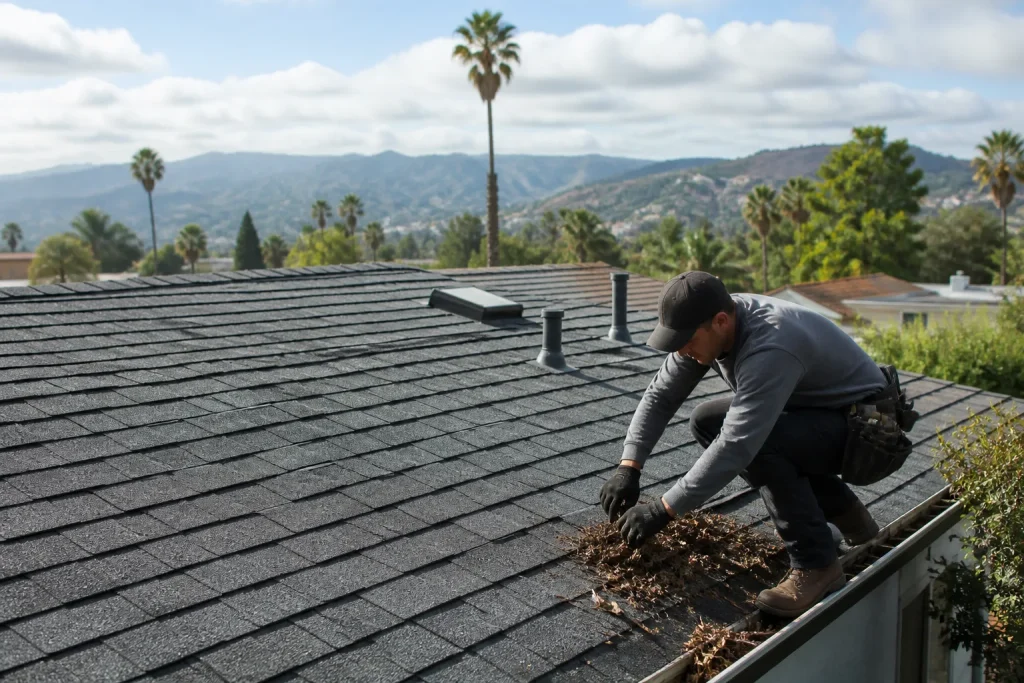
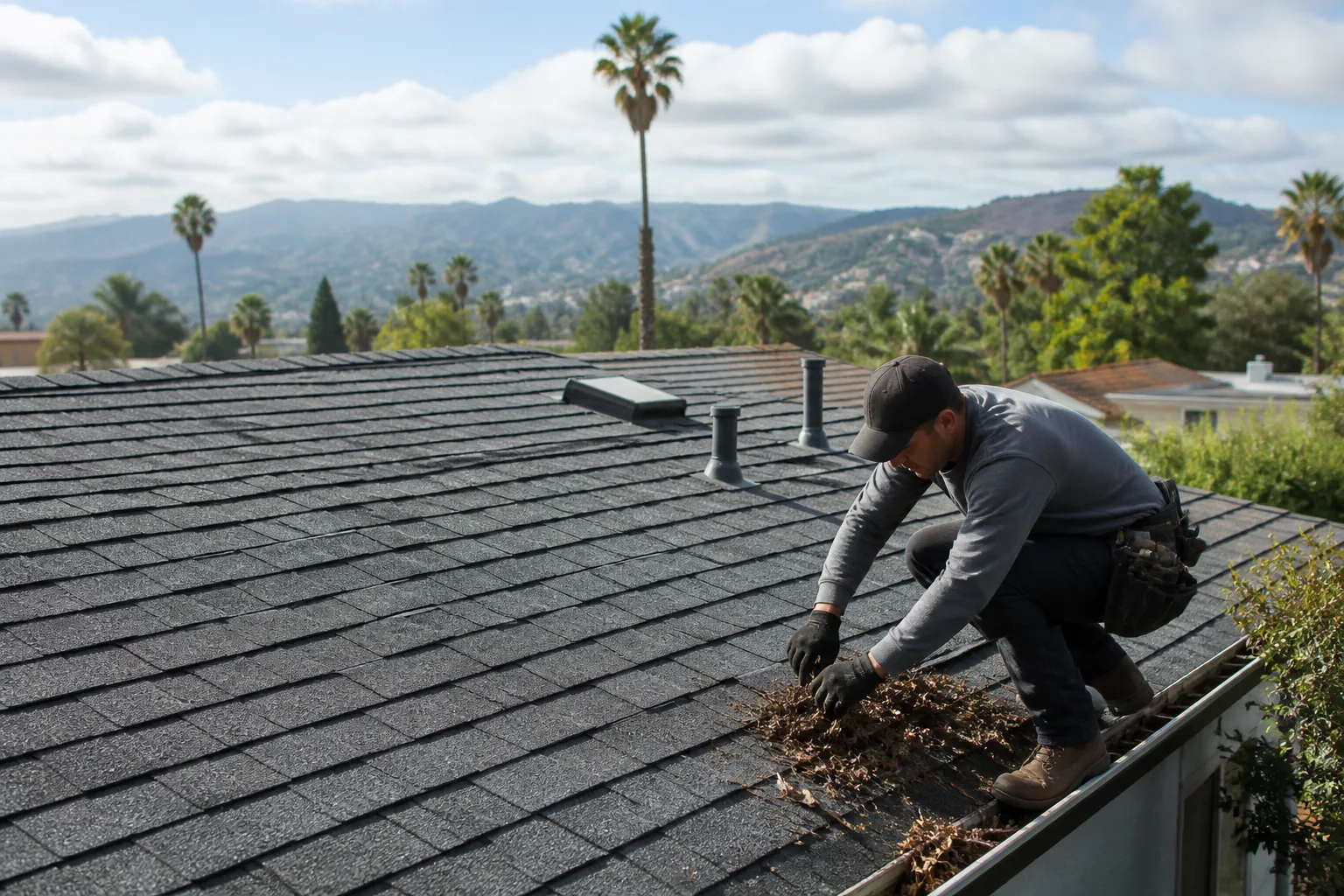
Preparing Your Home’s Roofing for Winter in Los Angeles
Preparing a Los Angeles roof for winter means taking its summer heat damage seriously before the first big rain. The dry months bake your roof at surface temperatures near 140°F, then sudden stormwater hits those same materials and finds every crack thermal cycling created. A basic pre-winter check of seals, gutters, and flashing, done every fall, prevents most of the interior leaks we see in January.
If you’d rather hand this off, call Mercer Roofing at (743) 200-8347 for a free estimate. We’ll send a background-checked, photo-badged technician with a written price before any work starts.
Why LA Winters Are Harder on Roofs Than You’d Think
Los Angeles gets about 15 inches of rain a year. That does not sound like much, especially if you’ve lived somewhere with real winters. But roughly 80% of that rain lands between November and March, and it lands on a roof that has been baking under relentless sun since May.
Here’s what matters: heat makes roofing materials expand. Cool nights make them contract. Do that six or seven hundred times across a single summer and the expansion joints, sealant beads, and caulked seams simply fatigue. They crack. Then a storm drops an inch of rain in an hour, and water travels through those cracks like it was invited.
The roof components that fail first in Los Angeles are predictable if you know where to look:
- Pipe boot seals: The rubber gasket around plumbing vent pipes. Sun cooks them until they split. A split pipe boot leaks directly into the attic and down the wall cavity.
- Valley caulking: Where two roof planes meet, old caulk pulls away from metal valley flashing. Water gets under the shingles at exactly the point where runoff volume is highest.
- Flashing edges: Around chimneys, skylights, and wall-to-roof intersections. The sealant line hardens, loses adhesion, and opens a gap wide enough for wind-driven rain to climb.
None of these failures look dramatic from the street in October. They look dramatic from inside your living room ceiling in February.
The Gutter Math Homeowners in Los Angeles Usually Miss
During a Los Angeles downpour, rainfall intensity routinely exceeds one inch per hour. On a 2,000-square-foot roof, that rate means 1,250 gallons of water per hour is trying to leave your roof through the gutter system. If the gutters are undersized, rusted at the seams, or blocked with eucalyptus debris, that water does not politely wait its turn. It backs up under the shingles, soaks the fascia board, and starts the slow work of rotting it.
We pulled a fully rusted-out gutter section off a home near El Segundo two winters ago where the fascia behind it had been wet for so long you could push a screwdriver through it by hand. The homeowner had no idea anything was wrong. The gutter looked fine from the ground, right up until a winter storm sent water cascading over the edge and down the stucco.
For Los Angeles homes specifically, the formula is worth repeating and writing down: storm intensity, not annual rainfall, determines gutter performance. A gutter system that handles a gentle mist fine can fail completely under a 90-minute Pacific downpour. What to check before November:
- No standing water in any gutter section after a dry 48-hour period.
- Downspouts terminate at least 4 feet from the foundation.
- Seams are sealed and not separating.
- Fascia boards behind gutters are firm, not spongy.
- Gutter hangers are spaced no more than 24 inches apart.
If your Los Angeles home has original 3-inch gutters, you may be undercapacity for modern storm events. Five-inch seamless aluminum is the practical minimum we recommend for most LA homes over 1,500 square feet.
Five-Point Ground Inspection You Can Do With Binoculars
You do not need to climb a ladder. A pair of decent binoculars and about 20 minutes from your yard or sidewalk gets you a real assessment of your roof’s condition heading into winter. Here’s the five-point check we teach Los Angeles homeowners who ask us what to look for.
1. Shingle edges. Look for shingles that are curled upward, cracked, or missing entirely. A curled shingle catches wind. A wind-lifted shingle becomes a water path within one storm.
2. Flashing lines. At every chimney, skylight, vent, and wall junction, the flashing should sit flat. Sunlight visible between flashing and shingle means the seal has failed.
3. Pipe boots. The rubber around vent pipes should be whole, not split or crumbly. If it looks chalky under binoculars, it is nearing the end.
4. Valley lines. Where roof planes meet, shingles should overlap tightly. Granules accumulating in gutters below a valley are a warning sign that the shingles in that valley are wearing fast.
5. Ridge lines. The cap shingles along the roof peak should be straight and secure. A sagging ridge line means the decking underneath may be compromised.
Any one of those five findings is not necessarily a full roof replacement. Often it’s a targeted repair. But in Los Angeles, where we go nine months without rain, deferred maintenance becomes emergency repair as soon as November arrives.
Palm and Eucalyptus: LA Trees That Attack Roofs Differently
Most national roof-prep guides talk about oak leaves and pine needles. Los Angeles has a different problem. Our canopy is dominated by palms and eucalyptus, and both species damage roofs in ways other trees don’t.
Palm fronds are not like ordinary branches. When one drops, it hits flat and heavy, like a sheet of plywood with a spear tip. A falling frond from a mature Mexican fan palm can crack a shingle or puncture the underlayment. And fronds that rest on the roof hold moisture against the surface for weeks at a time.
Eucalyptus has two issues. The first is leaf litter: the long, thin leaves interlock and form mats that block gutter flow faster than almost any other tree. The second is bark. Eucalyptus bark peels in long strips that, once in a gutter, create a dam that debris piles against. A single mature eucalyptus near a home can plug a gutter system within one leaf-drop cycle.
Before winter in Los Angeles, we recommend:
- Trim palm fronds so no part of the frond overhangs or touches the roof surface.
- Keep eucalyptus branches at least 6 feet from the roof edge.
- Clean gutters after leaf drop, even if you cleaned them in late summer.
- Remove any frond, branch, or leaf debris resting directly on shingles before the first storm. Debris holds moisture, and moisture invites moss and rot.
Tree maintenance is not roofing work, but a tree service that understands roofs will cut with the structure in mind. Ask for clearance, not just thinning.
What an Honest Pre-Winter Roof Inspection Report Should Include
A legitimate pre-winter roof inspection in Los Angeles produces a document you can read and understand. Not a verbal “it’s fine” and not a push to replace the roof by Friday. Here is what the report should look like.
A written condition summary for each roof plane. North, south, east, west, each listed with a specific note. “South face at about 60% service life, curling at edges” is useful. “Your roof needs help” is not.
Photographs. Every issue cited should have a photo showing it. You should be able to see the cracked pipe boot or the lifted flashing on your phone while the technician is still on site.
A price for any recommended repair, in writing, before you decide anything. At Mercer Roofing, the written price is not a negotiating tactic or a conditional offer. It’s the price. If the work is not right within 365 days, our Done Right Promise means we make it right.
No scare language. A report that says “catastrophic failure imminent, act now” is a sales script. A report that says “pipe boot seal at vent #3 is cracked, estimate to replace is $185, recommend completing before heavy rain” is a useful document.
If someone knocks on your door offering a free inspection after a storm, with no appointment, that inspection exists to generate a sale. At Mercer Roofing, the person who arrives will be someone whose name and photo were sent to you before they came. They’ll present a photo ID at the door, wear a clean, marked uniform, and have been background-checked through the Threshold Verified standard. If they find something, you’ll see it in a photo and get a written price. If they don’t find anything, they’ll tell you that too.
When to Call a Pro Instead of the Ladder
Most of the preparation on this list is ground-level work. If any of these apply to your Los Angeles home, this is the point where you bring in a trained roofer rather than climbing up yourself:
- Your roof pitch is steep enough that standing is uncomfortable, let alone working safely.
- You found flashing gaps or pipe boot damage during your binocular check.
- Your gutters have pulled away from the fascia, which usually means the hangers or the fascia board itself is failing.
- You see stains on interior ceilings or walls near exterior walls, which means water is already moving where it should not be.
- Your roof is over 20 years old and has not been professionally inspected in the last three years.
Roof work involves genuine fall risk, and some inspections require getting onto the roof surface. That is not a do-it-yourself job. The cost of a professional inspection is far lower than the cost of a hospital visit or a missed leak that quietly damages insulation, drywall, and framing for a full rainy season.
Related services in Los Angeles: Roof Repair in Los Angeles | Roof Installation in Los Angeles | Roofing Company in Los Angeles
The Bottom Line
Your Los Angeles roof enters winter already tired from summer. The right preparation is not complicated: check the seals that thermal cycling destroys, make sure gutters can handle 1,250 gallons per hour when a storm cell parks overhead, clear palm and eucalyptus debris, and get a written inspection report you can actually read. Do it before November, and you’ve removed most of the risk that turns a rainy season into a leak season.
If you’re in Los Angeles and want this handled without opening the door to a stranger, Mercer Roofing does it differently. You’ll get the name and photo of your technician before the visit, a photo ID badge at the door, and a written price before any work begins. Call (743) 200-8347 for a free estimate. A real person answers the phone, 24/7.
Frequently Asked Questions
Most Los Angeles roofing companies, including Mercer Roofing, offer free estimates and inspections for homeowners preparing for winter. A thorough inspection that produces a written report with photographs should not cost extra when it’s part of deciding on needed repairs. Be wary of companies that offer a free inspection and then return from the roof with a replacement pitch and a contract. The written inspection report should stand on its own, with line-item prices for any recommended work.
The best window in Los Angeles is late September through October, before the first significant rain. The summer heat has already done the damage it is going to do, so the seal cracks and flashing gaps are visible if you look. Repairs done in October have dry weather for proper sealant curing. Once the rains start, some roof repairs get pushed back because water on the surface prevents proper adhesion, which just extends the window where a leak can develop.
In our experience across Los Angeles, the most common winter roof problem is a failed pipe boot seal or flashing seam that goes unnoticed all summer. The crack is there in October but invisible unless you’re looking for it specifically. The first heavy rain channels water into it, and by the time the homeowner sees the ceiling stain, the water has already soaked the insulation and possibly the drywall. That’s why the ground-level binocular check matters: you can spot the failure before it becomes an interior problem.
A new roof installed within the last two or three years still benefits from a fall gutter cleaning and a quick check of the areas around penetrations and flashing. The materials should be sound, but a single shifted shingle from a summer wind event can happen on any roof, regardless of age. For newer roofs, the pre-winter effort is smaller: clean the gutters, check the flashing lines, and address anything obvious. For roofs older than 15 years, the inspection is doing more work because the sealants and rubber components have been through many more thermal cycles. When we install a new roof in Los Angeles with GAF, CertainTeed, or Owens Corning shingles, the goal is that the homeowner never has to think about leaks again, but a 20-minute check each fall is still worth the time.
Written by the team at Mercer Roofing.
Need Roofing Help?
Call Mercer Roofing - licensed & insured, here with fast after-hours help in Los Angeles.
(743) 200-8347