
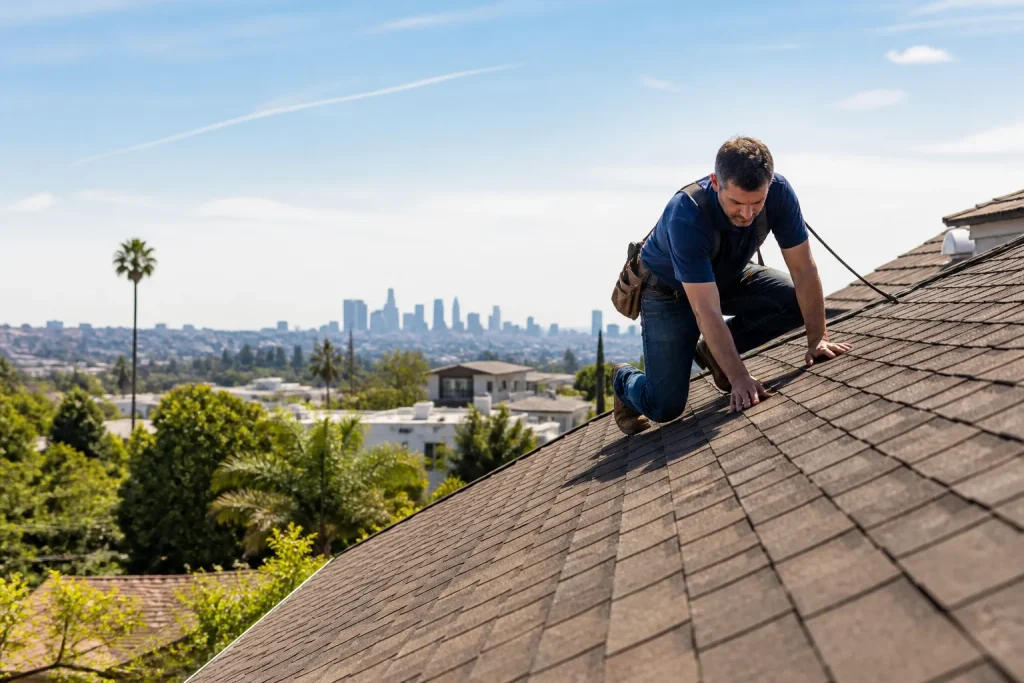
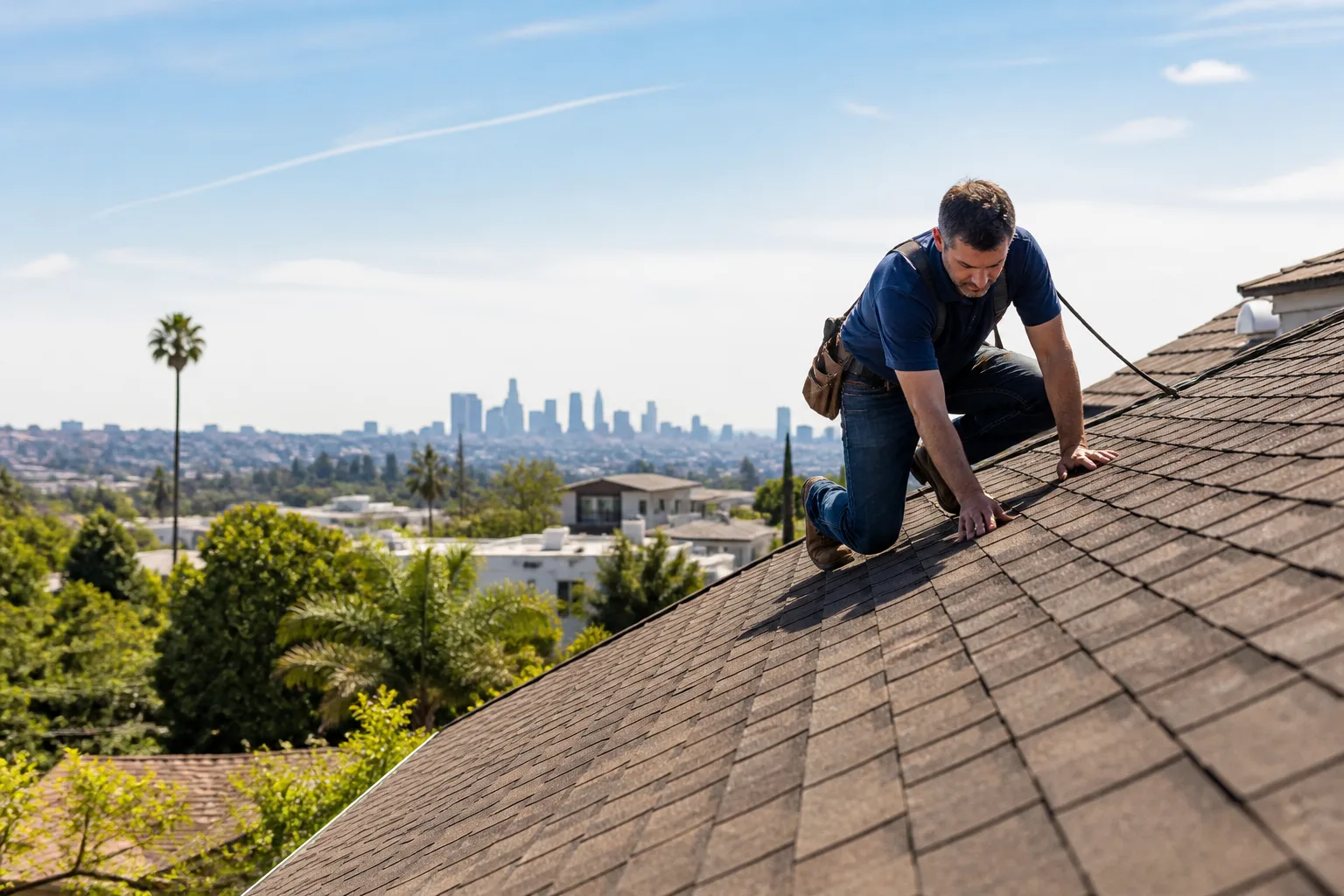
Spring Roofing Checklist for Los Angeles Homes
Spring roof maintenance in Los Angeles comes down to one priority: catching what winter rains exposed before summer heat bakes it into a bigger problem. A proper spring inspection focuses on storm-entry points, sealant failure, and debris from LA-specific trees like jacaranda and eucalyptus. If you’d rather not climb a ladder, call Mercer Roofing at (743) 200-8347 and we’ll handle the inspection for free.
Most roofing checklists floating around online were written for places with snow and ice dams. In Los Angeles, spring isn’t about shoveling snow off your roof or checking for frost heave. It’s the narrow window between the end of our rainy season and the start of the dry heat that turns small problems into interior leaks by August. Our technicians have pulled tarps off flat roofs in Silver Lake in March where ponding water had been sitting for weeks, invisible from the street, quietly working through the membrane. That’s the kind of thing this checklist is built to catch.
Key Takeaways
- Spring in LA is about post-rain assessment and pre-summer heat prep, not snow damage
- The attic check catches what exterior inspections miss: water stain patterns that reveal entry points
- Flat and low-slope roofs need special attention in Los Angeles, especially after winter ponding
- Flashing and sealant degrade from LA’s spring temperature swings between 35°F and 90°F
- Jacaranda and eucalyptus debris creates gutter blockages standard cleaning misses
- Document your findings with photos and notes before getting repair quotes
The Los Angeles Spring Roofing Logic: Why Timing Matters Here
In Los Angeles, the roofing calendar runs backward from most of the country. Our rainy season runs roughly November through March. Our dry season runs April through October, with brutal UV exposure and temperatures that regularly hit the high 90s throughout summer and fall. That means spring is not recovery from winter. It’s assessment of what winter revealed, followed by preparation for what summer will punish.
Here’s what that actually means on your roof. A small gap in flashing that leaked once during a February storm might dry out and look fine by April. But the moment summer heat arrives, the materials around that gap expand, the gap widens, and the next rain in November or December pours through a hole that’s now significantly larger. We see this pattern every year across Los Angeles, from the hillsides of Mount Washington to the flatlands of the Valley. The spring window is when that gap is still small, still cheap to fix, and still invisible from the ground. Waiting until fall means paying for interior damage on top of the roof repair.
The other LA-specific factor is UV. Our roofs take a beating from sunlight that most climates never experience. Shingle granules loosen, sealant dries and cracks, and underlayment bakes. By May, surface temperatures on a dark shingle roof in Los Angeles can hit 160°F. That’s hot enough to accelerate degradation of any material that’s already compromised. Spring is when you identify what’s compromised so it can be addressed before the heat does the damage for you.
Post-Rain-Season Attic Check: Reading the Decking
The single most valuable spring roofing task in Los Angeles happens inside your house, not on the roof. Your attic decking, the plywood or OSB panels that form the structural base under your roofing material, tells you exactly where water entered during winter storms, even when the exterior looks fine. If you have an accessible attic, this 20-minute check in March or April will save you thousands compared to discovering the problem from a ceiling stain in December.
Here’s how to read what you’re seeing. Fresh water stains on decking appear as dark, irregular patches with defined edges, often radiating outward from a single point. That point is your entry location. Older, recurring leaks show up as stains with concentric rings, like a topographical map, where the same spot has gotten wet multiple times. White or gray fuzzy patches are mold or mildew, meaning the moisture has been present long enough for organic growth, which is a sign of a persistent leak, not a one-time storm event. Rust-colored staining around nail heads, called nail popping, means moisture is wicking through fastener holes.
In Los Angeles, we look especially closely at decking in the areas where roof planes meet walls, around chimney penetrations, and near any plumbing vent stacks. Those are the three most common entry points we find, and they’re almost never visible from the street. The stain pattern inside the attic gives you the exact location to inspect on the exterior. Without that interior reading, you’re guessing.
Flat and Low-Slope Roofs: The LA-Specific Ponding Problem
Los Angeles has a notably high percentage of flat and low-slope roofs compared to most American cities, especially in mid-century neighborhoods like the Miracle Mile district, parts of West Adams, and throughout the San Fernando Valley. Flat roofs designed for a desert climate work fine until winter rains reveal their weaknesses. Spring is when ponding damage becomes visible, because the water has finally evaporated and left its evidence behind.
Ponding is any water that sits on a flat roof for more than 48 hours after rain stops. On a roof in Los Angeles with a slope of less than a quarter-inch per foot, that’s common. The problem is that standing water accelerates membrane deterioration, breaks down sealant at the seams, and in older built-up roofs, creates blisters that eventually crack. If you’re inspecting your own flat roof in spring, look for these signs: patches where the membrane has bubbled or wrinkled, areas where the surface gravel has thinned and exposed the underlying bitumen, and any spot that still feels soft or spongy underfoot, which indicates saturated insulation below the membrane.
What does correction cost? In the Los Angeles market, recoating a flat roof with a reflective elastomeric coating typically runs $3 to $6 per square foot. A full membrane replacement, when ponding has gone too far, runs $8 to $15 per square foot depending on the system (modified bitumen, TPO, or PVC). The difference between those prices is usually whether the ponding was caught in spring or ignored until the leaks started. We’ve seen flat roofs in Atwater Village where a $900 patch job in April would have prevented an $18,000 full replacement by September.
Flashing and Sealant: What LA’s Spring Temperature Swings Actually Do
Los Angeles spring temperatures swing dramatically. A March day might start at 38°F and hit 85°F by afternoon. Those 45-plus-degree daily swings cause every roofing material to expand and contract repeatedly, and the materials that suffer most are the ones doing the sealing work: flashing, caulk, and rubber gaskets around penetrations. This thermal cycling is the primary reason sealant failure is so common on Los Angeles roofs by mid-summer.
In our experience on roofs across Los Angeles, silicone and polyurethane sealants typically last 3 to 5 years in this climate before UV and thermal cycling break them down. Butyl rubber tape, used around skylights and some vent flashing, degrades in as little as 18 to 24 months here. The sealants that fail fastest are those exposed to direct southern sunlight, which in Los Angeles means south-facing rooflines and anything on the west side of the house that catches the afternoon heat.
For your spring checklist, examine every place where two different materials meet: where the roof meets a chimney, where a wall extends above the roof line, around skylights, around plumbing vents, and where the roof meets any dormer. Look for sealant that has cracked, pulled away from the surface, or turned chalky when you rub it. Any of these are signs the sealant is done and needs to be scraped out and replaced. This is a $150 to $400 fix when caught in spring. It becomes a $2,000-plus interior repair when ignored until the first big rain.
When to call a pro: If your attic check shows staining and you can’t locate the exterior entry point, or if the flashing around chimneys and skylights shows signs of pulling away from the surface, that’s not a caulk-and-hope situation. These are structural connection points that need proper removal, re-flashing, and sealing to stop water for good. A technician who knows what they’re looking at will find problems in 20 minutes that might take a homeowner three weekends to miss. Related services in Los Angeles: Roof Repair in Los Angeles and Roof Installation in Los Angeles.
Gutter Debris: Jacaranda and Eucalyptus Don’t Behave Like Normal Leaves
Los Angeles gutter problems in spring are different from what the rest of the country deals with. We don’t have autumn leaf dumps. We have jacaranda blossoms in late spring and early summer, and eucalyptus bark shedding year-round, with a heavy drop in spring. Both materials create mat-style blockages that standard gutter cleaning misses, because they don’t just sit in the gutter channel. They interlock and form a dense, water-resistant mat that sticks to the gutter walls and downspout openings.
Jacaranda blossoms are particularly troublesome. They’re small, sticky, and drop in enormous quantities over a two-to-three-week period in May and June. In neighborhoods like Pasadena, Sherman Oaks, and Long Beach where jacarandas line the streets, the blossoms fill gutters full, and then dry into a compacted layer that water flows right over. Eucalyptus bark is different but just as problematic: long, stringy strips that wrap around gutter supports and downspout screens, creating a lattice that catches every other piece of debris that comes along.
What do backed-up gutters do to a Los Angeles home over summer? Water that can’t drain through the gutter system backs up under the roof edge and into the fascia board. The fascia, the board that runs along the roofline and holds the gutters, rots when it stays wet. In Los Angeles, where summer brings no rain to flush the system, the moisture trapped in that mat of jacaranda and eucalyptus sits against the fascia for months. By August, you’ve got soft, rotted wood and a gutter pulling away from the house. What’s worse, the trapped moisture attracts termites, which are a year-round problem in Southern California. The spring gutter check should be a mandatory item, not an afterthought.
Documenting Your Spring Inspection Before You Get Quotes
Here’s a mistake we see Los Angeles homeowners make every spring: they call three roofing companies for quotes without having done any documentation first, and each company gives them a different scope of work because each one is working from a different assessment. One roofer says you need three patches, another says you need a full re-roof, and the homeowner has no way to know who’s being honest. Documentation solves that problem.
When you do your spring inspection, take photos of everything. Every stain in the attic, every cracked sealant line, every ponding area on the flat roof. Write down the date, the location of each issue, and what you observed. Then, when you call for a quote, you can say: “I have photos of water staining on the attic decking above the east bedroom, and I noted cracked sealant around the chimney flashing on the south side.” A contractor who hears that knows you’re not going to be sold a roof you don’t need. A contractor who tries to expand the scope beyond what your documentation shows is one you should be suspicious of.
This is what Mercer Roofing means by our written-price-before-work-starts policy. We’re not afraid of informed homeowners. We encourage the documentation, because when the scope is based on actual identified problems rather than a general contractor assessment with no baseline, the quote is accurate, the work is targeted, and there are no surprises on the invoice. Written prices and written guarantees are the way this business should work, and that’s how we’ve done it.
A Real Los Angeles Spring Find
We pulled one out of a garage over in Highland Park last March. The homeowner called because she’d noticed a small water stain on her garage ceiling and wanted it checked before it got worse. Our technician found an 18-inch section of fascia completely saturated behind the gutter, a gutter packed with a solid mat of eucalyptus bark, and three separate flashing penetrations that had been leaking into the wall cavity for what looked like at least two winters. The heavy rain in February had finally pushed water into a visible spot. The total repair came to about $1,600, which is not a small number. But if that wall cavity had kept soaking through another season, we’d have been looking at structural repairs, mold remediation, and a much bigger conversation. That’s why you check in spring. Small problems found now are cheaper than big problems found in November.
Your Spring Roofing Checklist: The Short Version
- Get in the attic. Look for water stains, mold, rust around nail heads, and anything that smells damp. Note the location of every issue.
- Inspect the flat roof (if you have one). Look for ponding areas, blisters, wrinkles, and thin spots in the gravel or coating.
- Check every flashing connection. Chimneys, skylights, vent stacks, and wall-to-roof intersections. Look for cracked, chalky, or pulled-away sealant.
- Clean the gutters thoroughly. Remove jacaranda blossoms and eucalyptus bark by hand, not just with a hose. Those materials don’t flush.
- Inspect the fascia. Run your hand along the board behind the gutters. Soft spots, peeling paint, or visible cracks mean water has been sitting where it shouldn’t.
- Document everything. Photos, notes, dates. This is your baseline for getting accurate quotes.
- If any of the above turns up something you can’t identify or would rather not fix yourself, call a professional. The cost of a spring repair is a fraction of the cost of a fall leak.
The Bottom Line
Spring roofing in Los Angeles is about reading what the rain left behind and preventing what the heat will do next. Your attic is your most valuable diagnostic tool. Your flat roof tells you more in March than it will all summer. Your sealant is silently degrading under the thermal cycling, and your gutters are filling with tree material that doesn’t behave like normal leaves. Document what you find, fix what needs fixing, and you’ll enter the dry season with a roof that’s ready for it. Mercer Roofing has been doing this work in Los Angeles, and we bring the same approach to every home: a written price before any work starts, a written guarantee on every repair, and a technician whose name and photo you’ll have before they ever knock on your door. If you’re in Los Angeles and need help with your spring inspection, call (743) 200-8347 for a free estimate. There’s a live person on the other end, any time of day.
Frequently Asked Questions
When is the best time to inspect a roof in Los Angeles?
March through May is the ideal inspection window in Los Angeles. The rainy season has ended, so storm damage is visible, and the summer heat hasn’t yet arrived to expand gaps and worsen problems. An inspection during this window catches issues while they’re still cheap to fix. Call (743) 200-8347 to schedule a free estimate.
How much does a spring roof inspection cost in Los Angeles?
Most basic visual roof inspections in Los Angeles run between $150 and $350, but many companies including Mercer Roofing offer free estimates for inspections that lead to repair work. A thorough attic-and-exterior check that includes documentation of findings is worth paying for if it identifies problems early. For an exact quote on your roof, call (743) 200-8347.
What are the most common spring roof problems in Los Angeles?
The most common spring findings on Los Angeles roofs are failed sealant around flashing and penetrations, ponding damage on flat roofs, gutter blockages from jacaranda blossoms and eucalyptus bark, and water stains on attic decking that pinpoint leak locations. These problems are all caught early by the checklist above. If you find any of these, call (743) 200-8347 for a professional assessment.
How do I know if my flat roof needs repairs or full replacement?
The key indicators on a flat roof are ponding water that persists more than 48 hours after rain, blistering or wrinkling of the membrane, thinning of the surface coating, and soft or spongy areas that indicate saturated insulation. Minor issues can be repaired with recoating at $3 to $6 per square foot. Full membrane replacement, when damage is extensive, runs $8 to $15 per square foot in Los Angeles. A professional inspection will tell you which category you’re in. Call (743) 200-8347 for an honest assessment.
Written by the team at Mercer Roofing.
Need Roofing Help?
Call Mercer Roofing - licensed & insured, here with fast after-hours help in Los Angeles.
(743) 200-8347