
Emergency Roof Repair Near Me: What Los Angeles Homeowners Should Do First
If water is coming through your ceiling right now, stop searching for a roofer and start moving your belongings. Emergency roof repair in Los Angeles typically costs $350 – $900 for a tarp and temporary seal, but the secondary water damage to furniture, electronics, and drywall often runs $2,000 – $8,000 more. The first 30 minutes determine which bill you pay. If you’d rather skip the triage and have someone handle it, call (743) 200-8347 and a live person at Mercer Roofing will answer, day or night.
Most emergency roof calls we get come in after the couch is already ruined. A homeowner noticed a drip at 2 a.m., spent 45 minutes Googling “emergency roof repair near me Los Angeles,” watched three videos, read two Yelp pages, and only then started looking for a bucket. By then, the water had spread across the ceiling joists, soaked the drywall, and dripped onto whatever sat below. The roof breach was a $600 fix. The contents and ceiling repair pushed it past $4,000. This guide walks through the order of operations that actually protects your home, your wallet, and your family, starting with what to do before anyone picks up a phone.
Stop the Interior Bleeding First: What to Do in the First 30 Minutes
Roof water follows gravity, not common sense. It pools, travels sideways along joists, drips through light fixtures, and sneaks into wall cavities. What starts as a single drip can saturate insulation and delaminate drywall within hours. Before calling anyone, Los Angeles homeowners should do these five things in order:
- Move everything out of the wet zone. Furniture, electronics, rugs, photo albums, anything on the floor or under the drip. Water migrates sideways across ceilings, so move items at least six feet beyond the visible stain.
- Place wide, heavy buckets or plastic bins under active drips. Put a towel or rag in the bottom to stop the infuriating drip-drip-drip sound and prevent splash-back. Empty them frequently.
- Photograph everything before you touch anything. Insurance adjusters need to see the water path, the wet drywall, the affected contents. Take wide shots and close-ups. These photos are the backbone of your claim in Los Angeles, where HO-3 policies vary widely on roof water coverage.
- Kill the power to any wet ceiling light or fan at the breaker. Water and energized fixtures are a fire risk. The breaker box should be reachable without stepping in water.
- Relieve the pressure if the ceiling is bulging. Place a large bucket directly under the bulge, then puncture the lowest point once with a screwdriver. This drains the pocket before the weight tears the entire drywall panel down. This is the one puncture you should make, and it should be deliberate, contained, and photographed.
A quick note on insurance: if you’re in Los Angeles, your first call after triage should be to your carrier. Water damage from a roof breach is often covered, but the roof repair itself may not be. The documentation you take now determines what they pay.
Why You Should Never Climb Onto a Wet Los Angeles Roof
We get it. Every homeowner wants to see the damage with their own eyes, especially when water is actively entering the house. But a wet roof, particularly the steep pitches common in Los Angeles hillside neighborhoods like Mount Washington, Silver Lake, and Echo Park, is genuinely dangerous. Composition shingles become slick, tile roofs crack under shifting weight, and a fall from even a single-story eave can break bones. The hospital bill will dwarf the roof repair.
Roof structures in Los Angeles also carry a hidden health concern: older homes built before the 1980s may have asbestos in the roofing felt, underlayment, or flashing. Disturbing those materials by walking on the roof, lifting shingles, or pulling off broken tiles can release fibers into the air and into your home. The same goes for tar-and-gravel roofs common on flat-roofed LA homes. Walking on them spreads the gravel, exposes the membrane, and can create new breaches.
Your job during an emergency is to protect the interior and document everything. The roof itself is best left to someone who works on it every day and carries the right safety equipment, training, and liability coverage. A 20-foot fall from a roof edge onto a Los Angeles concrete driveway is not how you want this story to end.
What to Ask a So-Called “Emergency Roofer” in the First 60 Seconds
Heavy rain in Los Angeles brings out the storm-chasers. They knock on doors in Sherman Oaks and Studio City within hours of a weather event, promising same-day tarps and cheap repairs. Some are legitimate. Many are crews that follow storms around the country and disappear before the warranty is worth the paper it’s printed on. In the pressured rush of a roof emergency, even careful homeowners lower their guard. That’s exactly what the bad actors count on.
When someone calls or shows up at the door claiming to be an emergency roofer, slow the conversation down and ask these five questions before agreeing to anything:
- “What is your technician’s full name, and can you text me a photo before they arrive?” A legitimate company will do this without hesitation. A storm-chaser will make an excuse. Every Mercer Roofing technician, per the Threshold Verified standard, sends their name and photo ahead of the visit and badges in with a photo ID at the door. If a company can’t tell you who is coming, don’t open the door.
- “Are you licensed and insured in California?” Ask for the license number and verify it at the CSLB website before anyone sets foot on your property. Unlicensed operators in Los Angeles can undercut prices because they carry no insurance and no accountability.
- “Will you put the price in writing before you start?” Oral estimates for emergency work have a way of growing. If they won’t put it on paper with a clear scope, walk away. At Mercer Roofing, a written price is provided before any work starts, every time, with no surprises on the invoice.
- “What exactly will you do today, and what gets deferred?” Any honest roofer will tell you that a tarp and temporary water barrier go up on day one, but actual shingle replacement or flashing repair happens on a later visit once the roof dries. Anyone promising a complete structural repair during a downpour on a saturated roof is lying.
- “What does your guarantee cover, and for how long?” Emergency repairs can fail when the underlying roof was already compromised. That is why the timeframe matters. Mercer’s 365-Day Done Right Promise means if the repair is not right within a year, we make it right at no charge, with a free second visit included if the repair fails.
The first 60 seconds on the phone tell you everything. A real roofing company answers with a live person, identifies themselves clearly, and volunteers the details you need to feel safe. A storm-chaser rushes you toward a deposit.
What “Same-Day” Actually Means in Los Angeles Traffic
Every emergency roofing ad in Los Angeles promises the same thing: “We’re on our way.” But geography and traffic are stubborn things. A crew in the San Fernando Valley cannot teleport to San Pedro in 20 minutes, no matter how urgent your leak. The city is 469 square miles of congested freeways, and an honest “same-day” timeline usually means two to four hours from the time you hang up the phone, depending on where you are and what the weather is doing.
Here is the realistic sequence for an emergency roof visit in Los Angeles:
- Hour 1: You call. A live person answers, confirms your address, and schedules a technician. At Mercer Roofing, you receive the technician’s name and photo before they leave.
- Hours 2 – 4: The technician arrives, shows photo ID at the door, and assesses the roof from ground level and from any safe access point. They identify the likely breach, check the attic if accessible, and document everything.
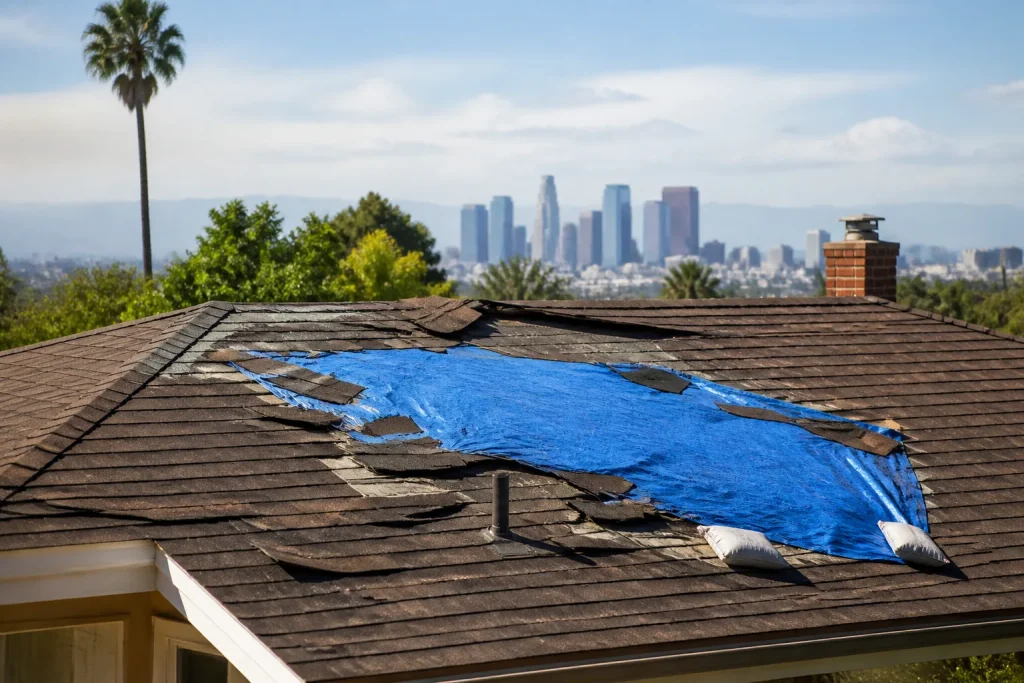
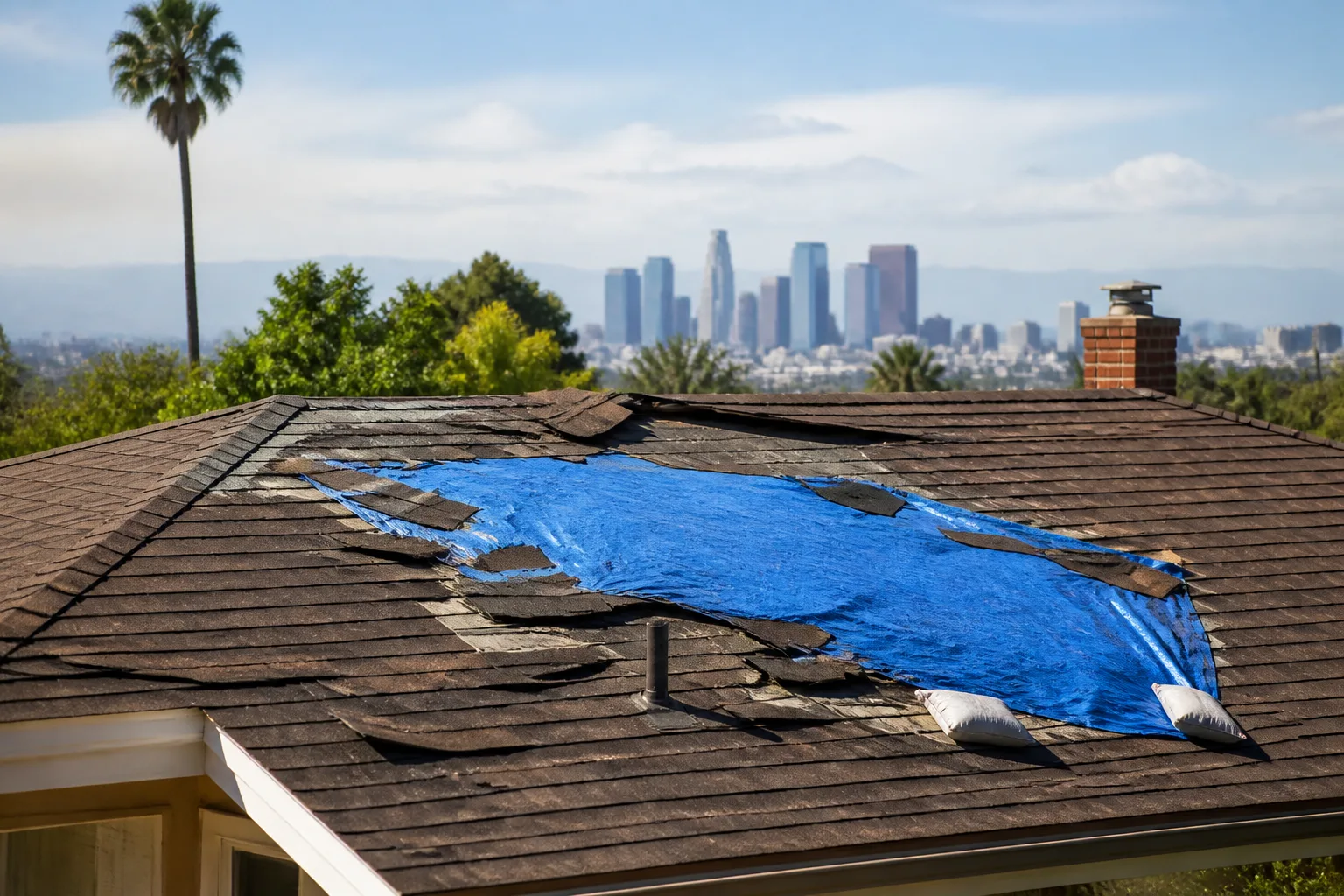
- Hour 4 or as soon as the roof is safe to touch: The technician installs a temporary tarp or water barrier over the breach and applies a temporary seal to stop active water entry. This is not the permanent repair, and no real roofer will call it that.
- Days 2 – 5: Once the roof is dry and the weather clears, the permanent repair happens: replacing damaged shingles, resealing flashing, repairing decking if needed, and checking the surrounding area for hidden damage.
During a heavy storm, a tarp is the goal on day one. A proper repair on a wet roof is like trying to tape a wound underwater. It won’t hold, and you’ll pay twice. We’d rather tell you the truth about timing than collect a check for a repair that fails next week.
How Much Does Emergency Roof Repair Cost in Los Angeles?
Transparent pricing matters, especially when you’re making decisions under stress. Here are the numbers we give Los Angeles homeowners when they call in an emergency, based on the work required:
- Emergency tarp and temporary seal: $350 – $700 depending on roof size and access difficulty. This secures the home immediately and buys time for the permanent repair.
- Shingle replacement, small area (under 100 sq ft): $400 – $800 including materials and labor. Most emergency shingle failures fall in this range.
- Flashing repair or replacement: $450 – $1,200. Los Angeles homes with complex rooflines or old galvanized flashing in hillside neighborhoods tend toward the high end.
- Decking replacement (if wood is rotted): $75 – $150 per sheet installed, plus the roofing layer on top. Older Los Angeles homes with years of minor seepage often reveal decking damage once the shingles come off.
- Full roof repair including underlayment and structural work: $1,500 – $4,500. This is rarer for a single emergency, but older roofs may need it.
These ranges assume a standard asphalt shingle roof. Tile roofs, the clay and concrete ones common across Los Angeles, run higher because of the specialized materials and the care required to avoid breaking adjacent tiles. A clear written estimate should show you the line items, and our practice at Mercer Roofing is to provide a written price before any work starts, always. If a company wants to start work on a verbal number, that is your sign to call someone else.
For a broader look at what roof work costs in this market, see our Roof Repair in Los Angeles page.
Why the Name and Photo Before Arrival Matters So Much in an Emergency
Every Mercer Roofing home claim starts with a simple fact: the person at your door is the person we said would be there. In a roof emergency, that fact matters more than ever. You are tired, stressed, maybe home alone with kids, maybe older and wary of strangers. Your guard is naturally down. That is precisely when a homeowner lets someone onto the property without verifying who they are.
We built our entire process around the Threshold Standard because we know the knot-in-your-stomach feeling of opening the door to an unknown contractor. Here is how it works: when you schedule an emergency visit with Mercer Roofing, you receive the technician’s name and photo before they arrive. When they ring the bell, they are in a clean, marked uniform with a photo ID badge. You match the badge to the photo on your phone. Then and only then do you open the door. If you’re one of the many Los Angeles homeowners who has put off roof work because you didn’t want a stranger walking through your bedroom, this is the difference between a company that understands and one that doesn’t.
Grant Whitlock, our owner, is the one who insisted on this standard back when Mercer Roofing was founded in 2000. He was a homeowner in Los Angeles long before he was a roofer, and he never forgot what it felt like to hand his house keys to someone he’d met 90 seconds earlier. The name-and-photo system exists because that feeling should not be part of a roof repair.
What to Do While You Wait for the Technician
Once you’ve called and scheduled, the waiting hours are not lost time. Here is a checklist for making the most of them:
- Clear a path to the attic access. The technician will likely want to inspect the underside of the roof deck from inside the attic if it’s safe to enter. Move boxes, holiday decorations, and anything else blocking the access panel.
- Document the water path with photos every time it changes. If a new stain appears or an existing one grows, add it to your photo file. Adjusters love documentation.
- Move vehicles away from the work zone. Technicians may need ladder access near the roofline. Clear the driveway side and any adjacent street parking.
- Secure pets. A roof visit means ladders, boots, and unfamiliar sounds. A frightened dog can slow the work and stress everyone out.
- Write down everything you noticed about when the leak started. Was it during heavy rain or after? Wind-driven? Did it start suddenly or build over weeks? This timeline helps the technician pinpoint the breach.
If the leak is severe and active, you can place a tarp on the floor with towels underneath as an extra floor safeguard. What you should not do is climb up with a caulk gun or try to patch the shingles yourself. The roof is wet. The pitch is steeper than it looks. The risk is not worth it.
When the Emergency Is Over: What Comes Next
Once the tarp is on and the water has stopped, the real work begins. Los Angeles homeowners often skip this part because the emergency passed and the tarp “looks fine.” But a tarp is a bandage, not a cure. Here is the path from emergency to done:
- File the insurance claim now, not later. Los Angeles policies have reporting deadlines. The photos and notes you gathered are your claim’s foundation.
- Schedule the permanent repair before the next rain. Los Angeles doesn’t rain often, but when it does, it comes in bursts. A tarp that survived this storm may not survive the next Santa Ana wind event. Tarps are no match for the gusts that whip through the foothills and canyons in this part of the county.
- Have the full roof assessed, not just the obvious damage. Water travels. The leak you saw in the living room ceiling may originate 15 feet away on a different slope. A thorough roof inspection catches the secondary issues before they become second emergencies.
- Consider the long-term fix. If your roof is over 15 years old and this is the second or third emergency repair, you may be due for replacement. A Roofing Company in Los Angeles that does both repair and full Roof Installation in Los Angeles can help you weigh repair against replacement with actual numbers, not pressure.
When the permanent repair happens, insist on shingle brands you can verify. We work with manufacturer-recognized products from GAF, CertainTeed, Owens Corning, IKO, Atlas, Tamko, and Boral. Your roof is a system, and the shingle is only the top layer. Underlayment, flashing, decking, and ventilation all matter. A written guarantee on the repair, which Mercer includes with every job, should be in your hand before the technician packs up.
The Bottom Line
An emergency roof leak in Los Angeles is a race between the water and your response. The homeowners who move belongings first, document carefully, and vet the roofer before opening the door are the ones who walk away with a contained bill and a dry house. The water moves fast. So should your triage. Then your phone call. If you’re in Los Angeles and need help right now, call (743) 200-8347 and a live person will answer, 24/7, not a voicemail or a callback form. We’ll give you a written price before any work starts, send you the technician’s name and photo before arrival, and back every repair with our 365-Day Done Right Promise. Roof emergencies are bad enough. The roofer should be the easiest part.
Frequently Asked Questions
A realistic emergency response time in Los Angeles is two to four hours from your call, depending on where you are in the city and what traffic looks like. Weather events push that timeline longer. A tarp and temporary seal go up on day one, and the permanent repair follows once the roof is dry. Call (743) 200-8347 and a live person at Mercer Roofing will answer immediately and give you an honest arrival window.
Protect your home’s interior first, photograph everything, then call your insurance company. The documentation you create before anything is moved or repaired determines what your Los Angeles carrier will pay. The roofer can come after the claim is filed, and the adjuster will want to see the damage plus your photos.
No. A responsible roofer will install a tarp or temporary seal to stop active water entry, then wait for the roof to dry before doing the permanent repair. Anyone who promises a full shingle replacement on a wet roof is cutting corners. The proper repair happens days later, once conditions are safe and dry.
Expect to pay $350 – $700 for an emergency tarp and temporary seal in Los Angeles, depending on your roof’s size and access. This is the stopgap that prevents further interior damage while the permanent repair is scheduled. A written estimate should itemize this cost before anyone climbs a ladder. Call (743) 200-8347 for an exact quote, free.
Written by Grant Whitlock, Owner at Mercer Roofing, serving Los Angeles since 2000.
Need Roofing Help?
Call Mercer Roofing - licensed & insured, here with fast after-hours help in Los Angeles.
(743) 200-8347